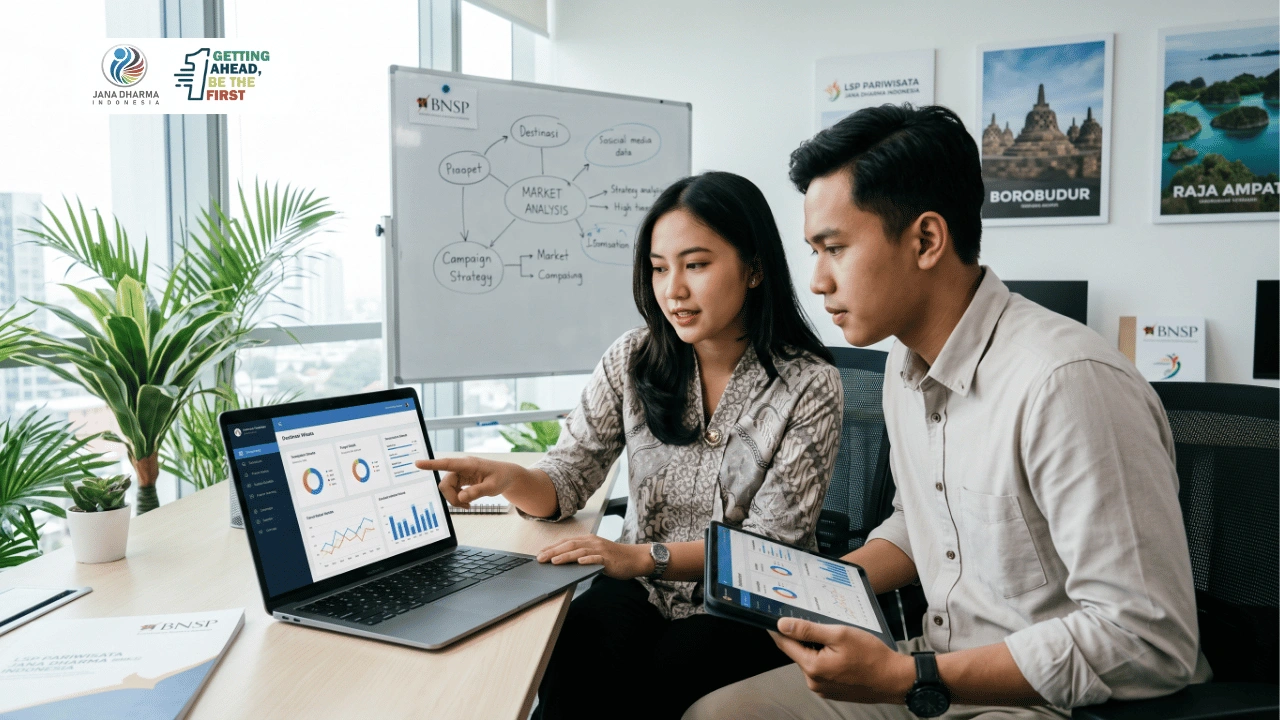
Referring to the standard reference skkni Ministry of Manpower and Testing Scheme BNSP, Mastery of STP and the Tourism Marketing Mix (7P) is a crucial qualification for professional tourism planners and consultants.
Based on our experience accompanying the certification assessor, the failure to prepare the marketing strategy document is generally rooted in the mismatch between targeting the target segment and the formulated 7P mix formulation.
Therefore, the application of this framework methodologically becomes the main basis before taking the official competency test.
How to apply the STP concept in tourism marketing?
The application of the concept of STP (segmenting, targeting, positioning) in tourism marketing is a systematic process of mapping the characteristics of tourists, choosing the most potential target groups, and instilling a unique perception of tourism products in the minds of visitors.
in accordance with destination development guidelines Kemenparekraf, STP analysis becomes the main foundation before the consultant determines the steps of the 7P marketing mix.
In designing a strategy, a tourism consultant must carry out three main stages in a structured manner:
-
Tourism Market Segmentation
The first step is to divide the heterogeneous tourist market into homogeneous groups. The consultant maps the audience based on geographic, demographic, psychographic, and behavioral aspects referring to market research indicators UN Tourism. This mapping ensures the analysis is based on real data in the field.
-
Target Pasar Destinasi Wisata
After segmentation, the consultant evaluates the attractiveness of each segment. The decision to determine the target market for tourist destinations is based on the growth potential, the level of profitability, and the carrying capacity of the region. Select the segment that best fits the destination advantage.
-
tourist product market position
The final stage is to formulate the market position of tourism products (Positioning). Consultants form unique image and value propositionsUnique Value Proposition) so that the destination has strong competitiveness compared to competitors.
For example, proper STP analysis will make it easier to prepare tourist destination marketing strategy highly competitive and sustainable.
What are the 7P elements in the tourism marketing mix?
The 7P element in the tourism marketing mix is the development of the traditional 4P concept specifically tailored to the characteristics of the tourism service industry. This mix includes Product, Price, Place, Promotion, People, Process, and Physical Evidence that are integrated with each other in creating a complete tourist experience.
Because tourism focuses on selling experience and services, four classic elements are no longer enough. Tourism consultants must manage all 7P elements so that operations and marketing run harmoniously according to tourism hospitality standards.
The following is an explanatory matrix along with an example of a 7P tourism industry:
| 7p element | Focus Explanation | example of 7p tourism industry |
| Product | Attractions, tour packages, and supporting facilities. | Cultural education tour packages or nature conservation tours. |
| Price | price structure, discount, and tariff-setting strategies. | Entrance ticket or lodging package All-inclusive. |
| Place | distribution channels and ease of accessibility. | Order via Online Travel Agent (OTA) or local agent. |
| Promotion | marketing communications and promotional activities. | Social media campaigns, cultural festivals, or travel exhibitions. |
| People | tour guides, managers and Hospitality Staff. | Training Hospitality and BNSP standard guidance. |
| Process | service flow from booking to post-visit. | Reservation system Online fast and neat arrival. |
| Physical evidence | physical evidence, cleanliness of the area, and infrastructure. | Spatial planning and cleanliness of public facilities. |
The consistent application of 7P tourism marketing elements will ensure tourists get a memorable experience according to the promise of promotion.
How to integrate STP and 7P in marketing plan documents?
Integrating STP and 7P in the marketing plan document is carried out by aligning each positioning decision result into the tactical formulation of the 7P mix.
Each 7P element must be specially designed to meet the needs and expectations of the target market segment that has been set.
In the preparation of the consultant’s work document, the results of the STP analysis become a guide in formulating the destination marketing mix strategy.
For example, if the selected target market is special interest tourists Ecological Tour, then the element Product must emphasize environmental education. Next, the Price adapted to the scheme Premium Pricing, while the element Promotion focused on community-based educational channels.
This integration process is a core part of how to make a tourism marketing plan professional and can be justified academically and practically.
Thus, the planning document does not only contain theory, but also operational instructions that are ready to be executed by the area manager.
Why is the understanding of STP and 7P crucial for BNSP certification?
The understanding of STP and the tourism marketing mix (7P) is very crucial for BNSP certification because the two frameworks are core competency units assessed by assessors.
The assessment is obliged to prove its ability to analyze the market and develop evidence-based marketing strategies in competency tests.
It is important to note that the BNSP certification test is different from the usual training. based on the provisions national certification system, professional certification aims to measure and test real competencies based on national work standards, not just providing teaching materials.
Therefore, consultant candidates must be able to present evidence of a work portfolio that applies a complete STP and 7P analysis.
In the Competency Assessment of Tourism Marketing Consultants, candidates will be asked to explain the reasons behind the selection of certain market segments and their relationship with the 7P mix design.
To prepare optimally, prospective participants can follow official referrals tourism marketing consultant young expert certification scheme.
The entire testing process is carried out independently under the auspices BNSP through LSP Jana Dharma Indonesia to ensure the validity and recognition of professional qualifications.
- whatsapp : 0813-8058-460
- instagram : @jana_dharma_indonesia
- Email : lspp.janadharmaindonesia@gmail.com
- address : Jl. Arimbi No.01, Kragilan, Sinduadi, Kec. Mlati, Sleman Regency, Special Region of Yogyakarta
FAQs About STP and 7P Tourism (FAQ)
What are the main differences between 4P and 7P in tourism?
The 4P concept (Product, Price, Place, Promotion) only includes a physical product mix. Meanwhile, 7P adds People, Process, and Physical Evidence which is very vital for managing service interactions and tourist experiences at destinations.
Which one was compiled first, STP or 7P?
STP analysis must be prepared first. Consultants need to determine market segments, targets, and positioning first so that the 7P marketing mix formulation can be designed on target.
Is the STP and 7P analysis required to be included in the BNSP assessment file?
Yes, the STP and 7P analysis documents are part of the main proof of employment portfolio. This document proves that the assessor has methodological competence in accordance with the requirements of the national work standards.