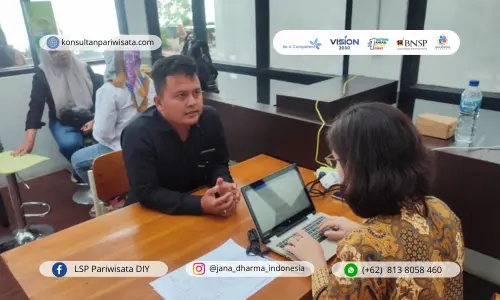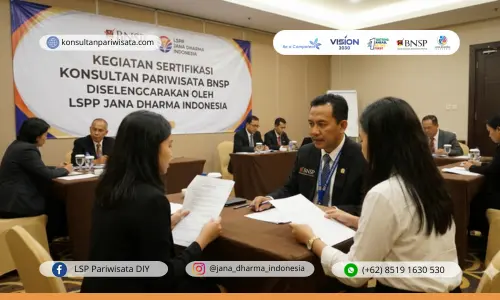
Facing the Competency Test of the National Professional Certification Agency (BNSP) often triggers an extraordinary sense of nervousness. Even though you are already proficient in your daily work, dealing directly with a professional assessor to prove your ability can be a challenge in itself. One of the most decisive stages is an interview or direct observation session, where your ability to answer questions will be tested in depth. This article will thoroughly discuss various tips for answering assessor questions in BNSP certification so that you can appear confident and be declared competent (K).
Understanding how BNSP assessors work
Before going into the answering technique, you need to understand what an assessor is looking for. The assessor is not looking for your fault, but looking for evidence that you have knowledge (Knowledge), skills (Skills), and work attitudeAttitude) in accordance with the Indonesian National Work Competency Standards (SKKNI).
In the world of certification, there is a principle known as VATM:
- Valid: The evidence you provide is really relevant to the unit of competence.
- Original: The evidence comes from your own work.
- Recent: Your ability is still valid and relevant to the current conditions of the industry.
- adequate: The available evidence is sufficient to show your competence as a whole.
Strategies and Tips for Answering Assessor Questions
Here are practical steps that you can apply during the assessment process:
1. Master the Competency Unit and Schema
Each certification has a specific scheme and unit of competence. Before the D-day, re-read the list of competency units that you take. Each unit has elements of competence and performance criteria (KUK). The assessor’s question is usually not far from the points in the yoke.
2. Use the STAR method in answering
When the assessor asks a situation-based question or experience (for example: “How do you handle customer complaints?”), don’t answer briefly. Use the method Star:
- Situation (Situation): Describe the background of the events briefly.
- Task (task): What are the responsibilities or challenges you faced at that time?
- Action (action): Explain in detail the steps you take. Make sure this action is in accordance with the Standard Operating Procedure (SOP).
- Result (result): What is the end result? Make sure the results are positive and show your success.
3. Answer based on SOP
Assessors really like systematic answers. Avoid answering with the sentence “Usually I…” without a clear basis. Use sentences like, “According to the SOP in our company, the first step I take is…”. This shows that you are a professional who works with standard standards, not just based on instinct.
4. Stay calm and think before speaking
If you get a difficult question, don’t be in a hurry to answer. Take a deep breath, pause for 2-3 seconds to compose a logic flow in the head. If you don’t understand the question, don’t hesitate to ask politely back, “Sorry sir/madam, can the question be explained more specifically about which point?”
5. Show a professional attitude (attitude)
Competence is not just a technical matter. The way you sit, the way you greet the assessor, to the way you look into the other person’s eyes is part of the work attitude assessment. Use good Indonesian, avoid excessive slang, and stay humble even if you are very skilled in that field.
Also read: Stop lonely visitors! The secret is in this superior destination management training
Types of questions that often arise
To help you prepare, here are the categories of questions that are usually asked by assessors:
A. Knowledge Questions (Knowledge)
This relates to basic theories and concepts.
- Example: “What is the function of the X tool in this production process?” or “Explain the OHS regulations that apply in your field of work.”
- Tips: Answer straightforwardly and use the right technical terms according to your field.
B. Case-based questions (contingency)
Assessors want to know how you react if something goes beyond the plan.
- Example: “What would you do if the system suddenly error When you are serving customers?”
- Tips: Focus on aspects of work safety and emergency procedures.
C. ROLE QUESTION (ROLE)
This relates to the limits of your responsibilities.
- Example: “Are you authorized to sign this document if your boss is not around?”
- Tips: Respond according to the limits of authority (job description) that apply professionally.
Also read: Listen and learn the requirements to become a tourism consultant in 2026
Common Mistakes You Should Avoid
Many of the assessors (certificates) fail not because they are unable, but because of the following errors:
- Too long-winded: Answering too long to get out of the core of the question.
- Answering “Forgotten”: This is the most dangerous answer. If you forget the technical terms, try to explain its function descriptively.
- does not bring supporting evidence: During the interview, make sure the portfolio or supporting documents are near you to show as physical evidence.
- against assessors: Even if you feel you are more right, don’t argue with the assessor in a high tone. Discuss with data-based arguments and industry standards.
Why is BNSP certification important for your career?
You may be wondering, why bother going through this process? In the era of global competition, having experience alone is often not enough. The BNSP certificate is an official recognition from the state that you are indeed an expert in your field. The advantages include:
- Increased credibility: You have valid evidence of your expertise.
- Salary bargaining power: Certified professionals tend to have a higher bargaining position in salary negotiations.
- Wider career opportunities: Many large companies and government agencies require professional certification as a requirement for recruitment or promotion.
Also read: Complete Guide to the Competency Certification List at SKPISO.id
Take Steps to Your Success Now in the Tourism Industry
If you are involved in the world of tourism, the challenges faced are certainly more dynamic because they are directly related to human satisfaction. Answering the assessor’s questions in this field requires a touch Hospitality strong in each of your answers.
You don’t have to feel alone in preparing for this process. To help you achieve the predicate competent professionally, Jana Dharma Indonesia Professional Certification Institute (LSP) Present as a trusted partner.
We provide a wide selection of tourism professional certification schemes that have been licensed by BNSP, including:
- Tourism Consultant Certification
- Hospitality Certification (Front Office, Housekeeping, Food & Beverage Service)
- Restaurant & Catering
- Tour guide certification
- MICE certification
- travel agency certification
- SPA certification & Wellness
With the support of supportive and experienced assessors, you will be guided to show your best potential without fear. Don’t delay anymore to improve your professional qualifications. Understanding the tips for answering assessor questions in BNSP certification is very crucial so that you can explain technical procedures while still showing a polite professional attitude.
Ready to become a competent workforce who is recognized by the state? Register now at LSPP JANA DHARMA INDONESIA And be part of a superior tourism professional. Visit our official website or contact our team for consultation on the most appropriate scheme for your career development!
For free consultation, contact us via:
WhatsApp: +62 813 8058 460 or +622123569054
Instagram: @jana_dharma_indonesia
Email : lspp.janadharmaindonesia@gmail.com