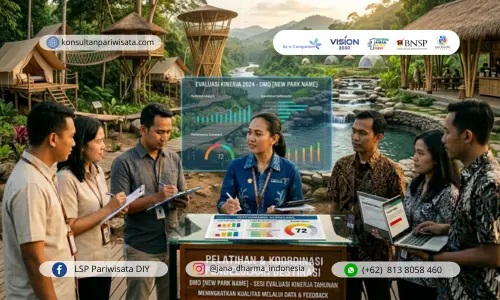
Many tourist destination managers feel they have worked hard, but do not know whether the hard work really has an impact. The question of how the performance of tourist destination management is measured to be one of the most crucial questions that must be answered by every manager, tourism office, and policy makers.
Measuring performance is not just calculating the number of visitors. It’s about knowing how healthy, competitive, and sustainable the tourist destinations you manage. This article will thoroughly explore indicators that are officially and academically used to measure the performance of tourist destination management.
Why is the performance measurement of tourist destinations important?
Without a clear measurement system, destination management runs aimlessly. Research Crotts & Magnini (2022) in international journals confirms that destinations must apply Key Performance Indicators (KPI) based on the four pillars of sustainability to improve performance consistently and measurably.
At the national level, the Ministry of Tourism and Creative Economy itself uses five main performance indicators which include the value of foreign exchange for tourism, the contribution of tourism GDP, the export value of creative economy products, the number of foreign tourists, and the movement of domestic tourists as a macro benchmark for Indonesia’s tourism performance. However, at the destination level, measurements must be more specific and operational. Let’s discuss more about the measurement of proper destination management performance.
Also read: Failed to manage destinations? Maybe you missed these 4 destination management strategies
Main indicators of tourist destination management performance measurement
1. Level of visits and repeated visits (Repeat Visitation)
The most basic indicator is the volume of tourist visits, both domestic and foreign. But what is more meaningful is Repeated visit rate. Successful destinations are not only very crowded, but also capable of making tourists come back. The higher the number of repeat visits, the stronger the value of sustainability that the destination offers.
2. Tourist Satisfaction Index (Visitor Satisfaction Index)
Tourist satisfaction can be measured through surveys, online reviews, and ratings on the quality of attractions, accommodation, accessibility, and the friendliness of the local community. This index reflects how well the entire destination ecosystem works in meeting visitors’ expectations.
3. Destination Competitiveness (TTCI/TTDI)
Globally, the competitiveness of destinations is measured using Travel and Tourism Competitiveness Index (TTCI) and Travel and Tourism Development Index (TTDI) of World Economic Forum. Both of these indexes assess factors such as infrastructure, business environment, natural and cultural resources, and tourism policies. At the local level, we can measure the competitiveness of destinations from their ability to attract new tourists while maintaining the loyalty of old visitors.
4. Visitor management performance (Visitor Management)
This aspect includes how the destination manages the density of visitors, queues, distribution of tourists at various attractions, as well as comfort and security while at the destination. Further, Research in North Bandung shows that the indicator Visitor Management can be mapped in four priority quadrants for continuous improvement.
5. Environmental Sustainability Indicators
The performance of the destination is also measured by its ecological impact, such as the level of waste management and water and air quality. In addition, the area of vegetation cover is maintained, as well as compliance with environmental regulations such as the standard CHSE (Cleanliness, Health, Safety, Environment Sustainability). Destinations with good scores on this indicator are more environmentally aware of tourists (Eco-Conscious Traveler) believe.
6. Local Economic Impact
How big the economic benefits that local people really feel are important indicators in community-based tourism. This includes an increase in the income of residents, the number of MSMEs involved, and the absorption of local workers in the tourism sector.
7. Institutions and Partnerships
Research on Identification of Performance Indicators of Tourism Village Management revealed that the performance of destination management cannot be separated from institutional quality. Then the strength of the partnership between stakeholders, the level of community participation, and the quality of the attractions offered. Destinations with strong institutional governance have proven to be more adaptive to change and crises.
Also read: Disassemble the tourism strategic planning formula that can change everything!
Measurement Framework: The Four Pillars of Sustainability Approach
Crotts & Magnini (2022) Recommend the measurement of destination performance based on the four pillars of sustainability: economic, environmental, socio-cultural, and governance.Governance). Each pillar has a specific KPI that can be monitored periodically through primary (survey) and secondary data (government data and digital platforms).
This approach is in line with the policy direction of the Ministry of Tourism and Creative Economy which places contributions to GDP, environmental conservation, and empowerment of local communities as the three main dimensions of national tourism performance.
Also read: MUST KNOW! The main foundation for building educational and cultural tourism is right
Measure appropriately, manage smartly through tourism destination management training
The performance of tourist destination management is measured not from one number, but from a combination of quantitative and qualitative indicators which include tourist satisfaction, repeated visits, competitiveness, environmental sustainability, local economic impacts, and institutional quality. The more comprehensive the measurements are made, the more accurate the improvements can be designed.
Understanding this measurement framework requires special capabilities that do not just come. This requires an in-depth understanding of the methodology, data, and structured destination management strategies. Improve your ability to manage and measure the performance of tourist destinations professionally. follow tourist destination management training With us and get various exclusive benefits:
- ✅ National and international standard-based curriculum
- ✅ Destination KPI measurement material practically and applicable
- ✅ Real case study of Indonesian tourist destinations
- ✅ Guided by experienced practitioners and academics
- ✅ Recognized official certificate of tourism industry
- ✅ Access the national tourism professional network
Register yourself now, because a superior tourist destination is born from a competent manager.
For free consultation, contact us via:
WhatsApp: +62 813 8058 460 or +622123569054
Instagram: @jana_dharma_indonesia
Email : lspp.janadharmaindonesia@gmail.com