Many tourist destination projects in Indonesia were built on a large budget, but ended up lacking in visitors, and even stopped operating. This phenomenon is not just a technical failure, but a reflection of the weakness of strategic planning, governance, and community involvement. Then, how to deal with tourist destinations that fail to operate? This article describes the root of the problem scientifically, along with real examples and recovery steps that you can apply.
Why do tourist destinations fail to operate?
The failure of urban tourist destinations is not a single event, it is an accumulation of various systemic factors. Based on research Permana, et al. (2025), there are at least six main factors that cause the tourist destination project to fail before or after operation:
1. Lack of local community involvement
Destinations developed without involving local residents tend to lose their cultural identity and social support. Local communities are not only the object of development, they are the main actors who maintain the sustainability of the destination. Without their participation, destinations will feel foreign and inauthentic in the eyes of tourists.
2. Improper planning and design
Design that is not responsive to the needs of visitors is a major obstacle. If accessibility, comfort, and visual appeal are not a concern since the planning stage, the destination will lose its competitiveness even before it is crowded with tourists.
3. Inadequate environmental management
Environmental aspects are often overlooked in development rush. In fact, destinations that are not able to maintain cleanliness, natural beauty, or ecological sustainability will quickly experience a decline in quality and tourists leave.
4. Incompatibility with market trends and tourist preferences
Today’s tourists are more selective. Destinations that are not able to adapt to trends, such as experience-based tourism, eco-tourism, or instagramable content will lag behind competitors.
5. Limited resources
Many regional tourist destinations are built without long-term maintenance budget planning. When the funds run out in the construction phase, operations are stopped.
6. Government crisis and unsupportive policies
Policy inconsistencies, weak coordination between agencies, and the absence of regulations that are clearly a ticking time bomb for the sustainability of tourist destinations. Without a legal umbrella and strong institutional support, destination managers will continue to run in place.
Also read: Failed to manage destinations? Maybe you missed these 4 destination management strategies
case study of failed tourist destinations in Indonesia
Cihampelas Terrace, Bandung
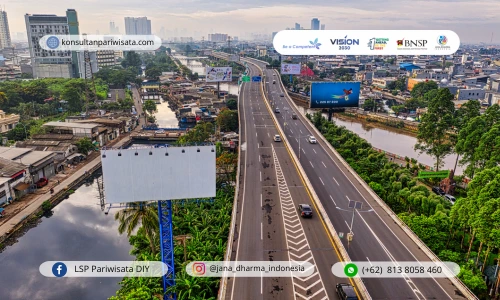
Teras Cihampelas was predicted to be an iconic tourist destination in Bandung. However, according to Permana, et al. (2025), the project faces a number of serious challenges due to the unfriendly design of visitors, unclear management policies, and lack of sustainable maintenance. As a result, the main goal of the project to become an attractive and sustainable tourist destination cannot be realized.
This case is a lesson that a magnificent physical development alone is not enough. This requires an integrated management ecosystem, ranging from operational SOPs, routine activation programs, to significant involvement of local traders.
Mini Zoo Purworejo Regency
The more worrying case came from the Mini Zoo of Purworejo Regency. Amanta and Supratiwi (2026) revealed that the failure to build a facility worth Rp9.4 billion was not just a technical problem, but a reflection of the failure of systemic public policies.
Some critical findings in this case:
- Determination of the location of the construction there is no support for a valid decree
- limited data on soil investigations from the start
- The feasibility study document that should be the basis for technical assessment and risk mitigation was only completed in November 2022, long after the construction began
This is a clear example of how reverse administrative procedures can drown the billions of rupiah project without ever providing real benefits to the community.
Also read: How is the performance of tourist destination managementImeasure? this is the answer
how to deal with tourist destinations that fail to operate
After understanding the root of the problem, here are the strategic steps that managers can take in overcoming tourist destinations that fail to operate:
1. Conduct a comprehensive audit first
Before taking any steps, identify the key failure points: is the problem in design, policy, HR, market, or a combination of all of them? This audit is the foundation of the entire recovery plan.
2. Community-based revitalization
Re-involve the local community in the recovery process. The form of a multi-stakeholder forum consisting of local governments, managers, local business actors, and representatives of residents. Collective ownership of the destination is the key to long-term sustainability.
3. Update the concept and positioning of the destination
Adjust the destination concept with the latest tourism trends and the real needs of target tourists. Feel free to do a total repositioning if the old concept is proven to be irrelevant.
4. Strengthen the legal basis and policy
Ensure that all operational aspects have a strong legal basis: SK Location Determination, Environmental Licensing, Management SOPs, and Transparent Supervision Mechanisms.
5. Build a sustainable funding model
Don’t just rely on the APBD. Exploration of alternative financing schemes such as public-private partnerships (PPP), community crowdfunding, or profit-sharing models with local investors.
6. Prepare a correct and timely feasibility study
Referring to the case of the Mini Zoo Purworejo, a feasibility study must be completed before construction begins, not after. This document is a compass that determines whether a project is worth continuing or not.
Also read: Proven! Here are the steps to study the feasibility of the destination to minimize risk
Close the doubts of the development of the destination by consulting us
The failure of tourist destinations is a serious problem that has an impact on the waste of the public budget, the loss of public trust, and the delay in local economic growth. But with the right approach, in-depth analysis, and the commitment of all stakeholders, even near-dead destinations can be revived.
Need a tourism destination development consultation? Are you a destination manager, local government, or an investor facing similar challenges? Immediately consult with us. With experience in tourism planning, destination revitalization, and public policy, we are ready to help you design measurable and sustainable solutions.
Contact us now And get the benefits of initial consultation, initial analysis of your destination, and strategic recommendations that suit field conditions.
For free consultation, contact us via:
WhatsApp: +62 813 8058 460 or +622123569054
Instagram: @jana_dharma_indonesia
Email : lspp.janadharmaindonesia@gmail.com